Data contracts have moved from conference talk to production necessity. A data contract is a formal, machine-enforceable agreement about the shape, semantics, and quality of data as it moves between producers and consumers — and in 2026, enforcement is what separates teams that trust their pipelines from teams that debug them at 2 a.m. This update explains what data contracts are, how enforcement works technically, which testing patterns win, and how to operate contracts across an organization.
核心要点:A data contract is an enforceable agreement on a dataset's schema, semantics, and quality between a producer and a consumer. Enforce it in CI and at runtime with schema, semantic, and SLA checks, version it like code, and own it at the producer. Start with one critical pipeline.
What Are Data Contracts in Production Pipelines?
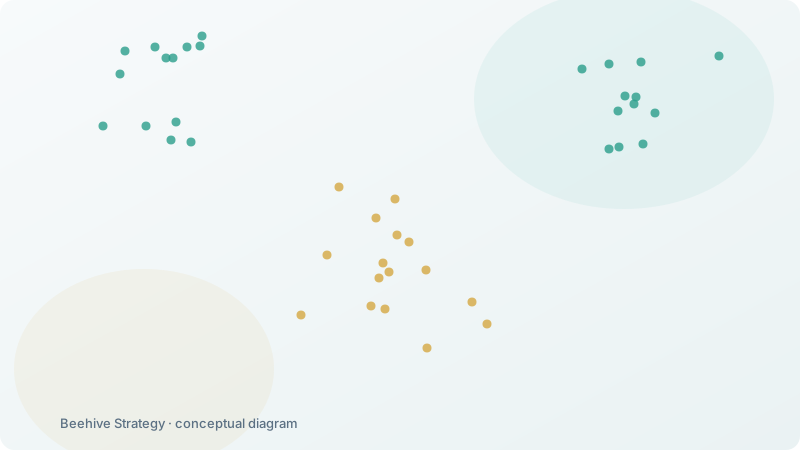
A data contract is a published, versioned agreement that specifies what a dataset or stream should look like and how it should behave: the schema, the types, the allowed ranges, the freshness and completeness expectations, and the meaning of each field. It lives as code, not in a wiki, so it can be validated automatically.
The mental shift is from implicit to explicit. Without a contract, a consumer silently assumes the producer's output; when the producer changes a column, the consumer breaks in ways nobody predicted. The contract turns that assumption into a shared, testable artifact owned by both sides.
Contracts sit between governance and engineering. They are narrower than a full data catalog but more enforceable than a document: a contract can fail a pipeline, blocking a bad change before it reaches downstream models and dashboards.
- A published, versioned, machine-checkable agreement
- Covers schema, types, ranges, freshness, and semantics
- Turns implicit assumptions into shared, testable artifacts
- Narrower than a catalog, more enforceable than docs
Why Does Data Contract Enforcement Matter in 2026?
Data pipelines now feed models and decisions, not just reports. A silent schema drift that once broke a dashboard now corrupts a feature store or a retrieval corpus, with consequences that compound. Enforcement is the guardrail that keeps the analytical and AI layers trustworthy.
The cost of breakage has risen while the cost of enforcement has fallen. Managed contract platforms and open formats mean a team can enforce contracts without building bespoke infrastructure. The ROI shows up as incidents avoided and on-call pages that never fire.
There is also a scaling argument. As the number of producer-consumer pairs grows, point-to-point trust stops working; you need a system of contracts. Organizations that enforce contracts treat data as a product with SLAs, which is precisely what AI-driven analytics demands.
The cultural effect is underrated. When a contract blocks a breaking change, the conversation moves from blame to design: producers and consumers negotiate the contract explicitly, and data quality becomes a shared metric rather than someone else's problem.
- Pipelines now feed models; drift corrupts feature stores and RAG
- Cost of breakage up, cost of enforcement down
- Scaling needs a system of contracts, not point-to-point trust
How Does Data Contract Enforcement Work Technically?
Enforcement compares actual data and metadata against the contract at two points. In CI, a proposed change to a producer is validated against the contract and against consumer expectations — often via contract tests — before merge. At runtime, the produced data is checked as it lands, and violations are blocked, quarantined, or alerted depending on severity.
The checks fall into tiers. Schema checks confirm structure and types. Semantic checks confirm business meaning — a status field only takes known values. Quality checks confirm distributions, null rates, and freshness against thresholds. SLA checks confirm the data arrives on time and complete.
Crucially, enforcement is fail-safe by design. A malformed event should not vanish; it should be routed to a dead-letter or quarantine so the producer can fix the source. The goal is to stop bad data from propagating, not to lose it — lineage and replay let you recover cleanly.
- Two gates: CI validation and runtime checks
- Tiers: schema, semantic, quality, and SLA checks
- Fail-safe: quarantine, not drop; enable lineage and replay
What Contract Testing Patterns Work Best?
The most reliable pattern is consumer-driven contracts. Consumers declare the fields and properties they depend on; the producer's CI fails if a change would break a consumer. This inverts the problem: the contract is defined by what is actually used, not by what the producer happens to emit.
A second pattern is producer-asserted contracts with conformance tests: the producer publishes a contract and tests its own output against it on every build. This works when the producer understands its consumers well, but it risks drift if consumer needs are not fed back.
A third, pragmatic pattern is differential testing at the boundary — compare a new producer version's output to the previous one and flag unexpected deltas. Use it as a safety net alongside the first two. Whichever you choose, keep the contract in version control and treat breaking changes as explicit, reviewed events.
- Consumer-driven: CI fails if a change would break a consumer
- Producer-asserted: producer tests its own output each build
- Differential at the boundary as a safety net
- Keep contracts in version control; review breaking changes
What Does the Data Contract Tooling Landscape Look Like in 2026?
By 2026 the category has consolidated around a few approaches. Open contract formats — such as those from the Open Data Contract Standard — let teams define contracts portably and avoid vendor lock-in. Managed platforms wrap enforcement, catalog, and observability into one offering, lowering the operational burden.
The integration point has standardized too: contracts attach to the pipeline's schema registry, transformation engine, or lakehouse table, so enforcement happens where the data already flows. This means you can add contracts without ripping out your existing stack.
When choosing, weight how naturally the tool fits your warehouse or lakehouse, whether it supports both batch and streaming contracts, and whether it gives you consumer-impact analysis — knowing which dashboards and models a change will break is the feature that turns contracts from paperwork into protection.
Adoption tends to start where the pain is sharpest — a lakehouse with frequent downstream breakages — and spread from there. Because enforcement rides existing infrastructure, the marginal cost of the second contract is far lower than the first, which is why the pattern compounds once a team commits.
- Open formats reduce lock-in; managed platforms lower burden
- Enforcement attaches to registry, engine, or lakehouse table
- Value consumer-impact analysis: know what a change will break
How Do You Operate Contracts Across Teams?
Contracts only work if someone owns them. The producer team owns the contract for its dataset; consumers own their expectations. A central data platform team provides the tooling and the standards, but should not be the bottleneck for every change.
Versioning is the operating discipline. Breaking changes get a new major version, a deprecation window, and a migration path; non-breaking changes are additive. Communicate changes through the contract's changelog so consumers are never surprised.
Finally, make contracts observable. Track violation rates, time-to-detect, and consumer impact as platform metrics. The teams that treat contract health like service health are the ones that stop incidents before users do.
- Producer owns the contract; consumers own expectations
- Central team provides tooling, not a bottleneck
- Version breaking changes; make contract health observable
How Do You Get Started with Data Contracts?
Start with one critical pipeline where a recent breakage caused pain. Define its contract — schema, key semantics, freshness SLA — and add a runtime check that quarantines bad data. Prove the pattern on a single high-value flow before spreading.
Next, introduce consumer-driven tests so changes are validated against real dependencies. Wire contract violations into your existing alerting so they page the right team. Resist building a grand contract program; let the second and third pipeline adopt the same pattern organically.
The common failure is treating contracts as a documentation project. They are enforcement mechanisms. The win comes when a bad deploy is blocked automatically and the producer fixes the source — not when a wiki is updated. Aim for prevention, measured by incidents avoided.
- Start with one painful pipeline; quarantine bad data
- Add consumer-driven tests; wire violations to alerting
- Treat as enforcement, not docs; measure incidents avoided
A Worked Example: Building and Evolving a Data Contract for a Customer 360 Data Product
To illustrate how data contract enforcement moves from theory to practice, consider a mid‑size retail organisation that wants to expose a Customer 360 view to its personalisation engine, marketing analytics team, and fraud‑detection service. The source system is a change‑data‑capture (CDC) stream from the legacy CRM, enriched with web‑session events stored in a Kafka topic. The goal is to publish a versioned, machine‑checkable contract that guarantees the shape, semantics, and freshness of the downstream dataset.
Step 1 – Discover the Producer‑Consumer Boundary
The data‑product owner (the CRM team) meets with the three consumer leads. They capture the following implicit assumptions:
- Consumer A (personalisation) expects a
customer_id(UUID),email(string, RFC 5322),lifetime_value(decimal, two‑digit precision) and asegmentenum with valuesbronze,silver,gold,platinum. - Consumer B (marketing analytics) requires a
last_purchase_tstimestamp with millisecond precision, apreferred_channelstring limited toemail,sms,push,social, and agdpr_consentboolean that must betruefor any marketing‑related field. - Consumer C (fraud detection) needs a
device_fingerprintSHA‑256 hex string, arisk_scorefloat between 0 and 1, and aflagsarray of strings where each entry must belong to the set{“velocity”, “location_mismatch”, “new_device”}.
These points become the contract’s semantic and quality clauses.
Step 2 – Encode the Contract as Code
The team chooses the open‑source datacontract-cli format (YAML) and stores the file in the producer’s Git repository under contracts/customer_360/v1.yaml. A snippet illustrates the structure:
version: 1
schema:
  type: struct
  fields:
    - name: customer_id
      type: string
      format: uuid
      required: true
    - name: email
      type: string
      format: email
      required: true
    - name: lifetime_value
      type: decimal
      precision: 10
      scale: 2
      required: true
    - name: segment
      type: string
      enum: [bronze, silver, gold, platinum]
      required: true
    - name: last_purchase_ts
      type: timestamp
      unit: millisecond
      required: false
    - name: preferred_channel
      type: string
      enum: [email, sms, push, social]
      required: false
    - name: gdpr_consent
      type: boolean
      required: true
    - name: device_fingerprint
      type: string
      pattern: '^[0-9a-f]{64}$'
      required: false
    - name: risk_score
      type: float
      minimum: 0.0
      maximum: 1.0
      required: false
    - name: flags
      type: array
      items:
        type: string
        enum: [velocity, location_mismatch, new_device]
      required: false
semantics:
  - description: "lifetime_value reflects net revenue attributed to the customer over the full relationship."
    field: lifetime_value
  - description: "gdpr_consent must be true whenever preferred_channel is set for outbound marketing."
    rule: "if preferred_channel is not null then gdpr_consent == true"
quality:
  - freshness:
      max_lag_seconds: 300
      metric: event_time - processing_time
  - completeness:
      threshold: 0.98
      fields: [customer_id, email, lifetime_value, segment]
  - uniqueness:
      key: [customer_id]
      threshold: 1.0
Because the contract lives as code, any change to the producer’s Avro schema or CDC mapping triggers a CI pipeline that runs datacontract test against the contract.
Step 3 – Contract Testing in CI
The CI job performs three layers of validation:
- Schema compatibility – compares the proposed Avro schema with the contract’s
schemablock using backward/forward compatibility rules. - Semantic checks – executes a small Spark job that reads a sample of the CDC stream, evaluates the
gdpr_consentrule, and flags any rows wherepreferred_channelis present but consent is false. - SLA checks – calculates the average lag of the last 10 k events; if it exceeds 300 s the job fails.
Only when all three pass can the change be merged to main. The pipeline also publishes a contract version badge to the internal developer portal, making the contract visible to consumers.
Step 4 – Runtime Enforcement
At runtime, a lightweight side‑car agent (built on the OpenTelemetry collector) sits between the Kafka producer and the topic. For each record it:
- Validates the Avro payload against the contract’s schema.
- Evaluates the semantic rule and the
flagsenum. - Checks the event timestamp against the freshness SLA; if the lag is too high the record is routed to a
dead‑lettertopic and an alert is raised via PagerDuty.
Violations are captured in a contract‑compliance dashboard that shows the percentage of good records per hour, enabling the producer to spot drift before it impacts downstream models.
Step 5 – Evolving the Contract
Six months later the marketing team wishes to add a consent_version field to track changes in GDPR policy. The producer creates a new contract version v2.yaml that adds the field as optional, preserves all existing constraints, and bumps the version number. The CI pipeline now runs contract tests against both v1 and v2 (consumer‑side tests are version‑agnostic, they simply reference the latest contract they have subscribed to). Consumers can opt‑in to v2 by updating their subscription; until they do, the producer continues to emit v1‑compatible records, guaranteeing backward compatibility.
This worked example demonstrates the full lifecycle: discovery, codification, automated testing, runtime guarding, and governed evolution — all of which turn an informal data hand‑shake into a product‑grade, enforceable asset.
Practical Implementation Checklist: From Contract Definition to Production Enforcement
Adopting data contracts at scale requires a repeatable, lightweight process that fits into existing DevOps workflows. The checklist below distils the essential steps into phases that any data‑engineering team can adopt, regardless of whether they use a managed platform or an open‑source stack.
Phase 0 – Preparation
- Identify a high‑value data product (e.g., a feature store table, a ML training dataset, a real‑time event stream).
- Assign a contract owner (usually the producer team) and a consumer liaison.
- Agree on the contract format (YAML, JSON Schema, or Protobuf‑based IDL) and store it in the producer’s repository.
Phase 1 – Contract Authoring
- List all fields consumed by downstream users; capture type, format, precision, and any enum or pattern constraints.
- Document semantic meaning in plain language and, where possible, encode as executable rules (e.g., “if discount > 0 then loyalty_points ≥ discount × 10”).
- Define quality expectations:
- Freshness: maximum allowable lag (seconds) between event time and processing time.
- Completeness: minimum percentage of non‑null values for critical fields.
- Uniqueness: key columns that must be duplicate‑free.
- Validity: value ranges, regex patterns, or cross‑field constraints.
- Version the contract using semantic versioning (MAJOR.MINOR.PATCH) and tag the initial release as
v1.0.0.
Phase 2 – CI Integration
- Add a contract‑testing step to the producer’s build pipeline:
- Schema compatibility check (backward/forward).
- Unit‑style semantic tests using a sample of production‑like data.
- SLA validation (latency, throughput).
- Fail the build on any contract violation; surface the error in the pull‑request discussion.
- Publish the contract artefact (e.g., a
.yamlfile) to an internal artefact repository alongside the build version.
Phase 3 – Runtime Guarding
- Deploy a contract‑enforcement side‑car or stream processor (e.g., Flink, ksqlDB, or a custom OpenTelemetry‑based filter).
- Configure the enforcement mode:
- Blocking: reject non‑conforming records and send them to a dead‑letter queue.
- Quarantine: allow the record to proceed but tag it for downstream inspection.
- Alert‑only: emit a metric or log entry without affecting flow.
- Instrument the enforcement component with Prometheus counters for
contract_valid,contract_invalid_schema,contract_invalid_semantic, andcontract_sla_breach. - Create a dashboard that surfaces the violation rate per contract version and per consumer group.
Phase 4 – Consumer Onboarding
- Provide consumers with a generated client stub (e.g., a Pydantic model, a Protobuf class, or a TypeScript interface) derived from the contract.
- Offer a version‑negotiation endpoint where consumers can declare the contract version they require; the producer can then emit a compatibility matrix.
- Collect consumer feedback through a quarterly contract‑review meeting; record any requested changes as new contract issues.
Phase 5 – Governance & Improvement
- Track contract evolution in a changelog linked to the repository’s release notes.
- Measure the impact of enforcement: number of blocked incidents, mean time to detect (MTTD) schema drift, and reduction in data‑related PagerDuty pages.
- Iterate the checklist: add steps for data‑mesh domain ownership, automated contract discovery, or AI‑driven anomaly detection as maturity grows.
By following this checklist, teams can move from ad‑hoc documentation to a self‑service, enforceable data‑product model that scales with the number of producer‑consumer pairs.
Common Pitfalls in Data Contract Enforcement and How to Avoid Them
Even with the best intentions, organisations often stumble on predictable obstacles when introducing data contracts. Recognising these pitfalls early and applying concrete mitigations can save months of rework and preserve trust in the programme.
Pitfall 1 – Treating Contracts as Static Documentation
Some teams author a contract once, store it in a Confluence page, and never revisit it. Consequently, the contract drifts from reality, and enforcement becomes a source of false positives.
Mitigation: Keep the contract under version control alongside the producer’s code. Automate contract validation in CI so that any change to the producer’s schema or logic triggers a re‑check. Use contract‑testing frameworks that can generate a diff between the current contract and the observed data profile, prompting a version bump when necessary.
Pitfall 2 – Over‑Engineering Semantic Rules
Attempting to encode every conceivable business rule (e.g., complex multi‑table correlations) in the contract leads to unwieldy YAML, slow tests, and low adoption.
Mitigation: Limit the contract to atomic semantics that can be evaluated on a single record or a small window. Reserve cross‑record or cross‑dataset validations for separate data‑quality monitoring tools (e.g., Great Expectations, Monte Carlo). Keep the contract focused on schema, basic ranges, enumerations, and freshness/completeness SLAs.
Pitfall 3 – Ignoring Consumer Versioning Needs
Producers sometimes push breaking changes without providing a migration path, forcing consumers to scramble or stay on an outdated contract version.
Mitigation: Adopt semantic versioning for contracts and maintain a compatibility matrix. When a MAJOR version is introduced, keep the previous MINOR version alive for a deprecation period (e.g., 8 weeks) and emit both versions side‑by‑side. Provide a consumer‑friendly migration guide that outlines the exact field changes and any required code updates.
Pitfall 4 – Misaligned Ownership and Incentives
If the producer team sees contract enforcement as an extra overhead with no clear benefit, they may resist or bypass checks, undermining the whole programme.
Mitigation: Tie contract compliance to the producer’s service‑level objectives (SLOs). Expose contract‑violation metrics in the team’s observability dashboard and celebrate reductions in data‑related incidents in retrospectives. Recognise teams that achieve zero contract breaches with internal awards or budget incentives.
Pitfall 5 – Neglecting Observability of Enforcement Itself
Teams often monitor the data but forget to watch the enforcement component, leading to silent failures where bad data slips through because the side‑car crashed or was mis‑configured.
Mitigation: Treat the enforcement service as a critical piece of infrastructure. Instrument it with the same metrics (latency, error rate, throughput) as any other pipeline component. Set up alerts for enforcement‑process crashes, excessive dead‑letter volumes, or sudden drops in validation throughput.
Pitfall 6 – Underestimating Cultural Change
Contracts shift the conversation from “who broke the pipeline?” to “how do we evolve the agreement?” Teams accustomed to blame‑centric post‑mortems may view contract negotiations as adversarial.
Mitigation: Frame contract reviews as collaborative product‑design sessions. Use a lightweight ritual: before any contract change, the producer presents the proposed update, consumers raise concerns, and the group agrees on a version‑bump plan. Capture the outcome in a shared contract‑evolution log that becomes a living record of data‑product stewardship.
By anticipating these pitfalls and applying the corresponding safeguards, organisations can transform data contracts from a theoretical safeguard into a practical, trusted pillar of their data‑analytics ecosystem.
What to Watch in the Next 12 Months: Emerging Trends in Data Contract Enforcement
The data‑contract landscape is evolving rapidly, driven by the convergence of AI‑augmented development, data‑mesh architectures, and stricter regulatory expectations. The following trends are likely to shape how organisations author, test, and enforce contracts over the coming year.
Trend 1 – AI‑Assisted Contract Authoring
Large language models (LLMs) are being fine‑tuned on corporate data dictionaries and past contract versions to suggest field definitions, semantic rules, and SLA thresholds. Early adopters report a 30‑40 % reduction in the time required to draft a first‑version contract.
Implication: Teams will shift from manual authoring to reviewing and curating AI‑generated drafts, accelerating onboarding of new data products while maintaining governance through human‑in‑the‑loop approval.
Trend 2 – Contract‑First Data‑Mesh Domains
In a data‑mesh, each domain owns its data products as publish‑subscribe contracts. Emerging platforms (e.g., DataOS, Atlan) now provide a contract registry that automatically discovers domains, enforces version compatibility, and generates client SDKs for multiple languages.
Implication: The contract becomes the primary interface between domains, reducing the need for point‑to‑point integration scripts and enabling autonomous, self‑service data consumption.
Trend 3 – Real‑Time Contract Drift Detection
Instead of relying solely on batch CI checks, stream‑processing frameworks are embedding lightweight statistical profilers that continuously compare incoming data against the contract’s statistical bounds (e.g., mean, variance, cardinality). When a drift exceeds a configurable threshold, the system can trigger an automated contract‑version proposal or a data‑owner alert.
Implication: Enforcement moves from a gate‑keeping model to an observability‑driven feedback loop, allowing organisations to catch subtle shifts (such as gradual changes in user‑behaviour encoding) before they affect downstream models.
Trend 4 – Regulatory‑Ready Contract Templates
With the EU’s AI Act and forthcoming US AI liability rules, regulators are beginning to ask for evidence that data used in model training meets specific quality and provenance standards. Contract templates that embed fields for data_lineage, bias_mitigation_flag, and retention_period are appearing in industry‑specific consortia (healthcare, finance).
Implication: Organisations that adopt these templates early will be able to produce audit‑ready artefacts directly from their contract repository, simplifying compliance reporting.
Trend 5 – Contract‑Aware Data Observability Platforms
Observability vendors are adding contract‑aware dashboards that correlate contract violations with anomalies in model performance, feature‑store latency, or business KPI drops. This creates a closed‑loop signal: a contract breach → alert → root‑cause analysis → contract refinement.
Implication: The value of contracts expands beyond preventing bad data; they become a leading indicator of data‑health that informs both engineering and product decisions.
Preparing for the Trends
To stay ahead, consider the following actions:
- Pilot an LLM‑based contract‑authoring assistant on a low‑risk data product and measure time‑savings.
- Evaluate a contract registry that integrates with your existing service mesh and provides auto‑generated SDKs.
- Add a lightweight stream‑profiler to your enforcement side‑car that publishes drift metrics to Prometheus.
- Draft a regulatory‑aligned contract template for your most sensitive data domain (e.g., PII‑rich customer data) and run an internal audit exercise.
- Work with your observability vendor to enable contract‑violation correlation panels in your existing dashboards.
By embracing these emerging directions, organisations can transform data contracts from a static safeguard into a dynamic, intelligent fabric that underpins trustworthy AI and analytics at scale.